
The Drive
I’m in The Gambia with my travel buddy, Lee. We’re up the Gambia River which defines this country so much so that the country’s borders parallel the river for most of this nation, the smallest in mainland Africa.
The Gambia is in West Africa and has a coast on the Atlantic. The Gambia is completely engulfed in Senegal except at the coast. Its weird border is the result of the kooky logic of the Brits and French, two of the many European colonial powers that were in Africa.
It’s named The Gambia instead of just Gambia because people were confusing it with Zambia, also in Africa.
The colonial powers were very good at making borders with disregard for the people groups, splitting up groups all over Africa like the Ewe in Ghana and Togo.
Yesterday we traveled six hours by boat from even farther up river. Along the way we saw many different birds species, a croc and two hippos.
But, today we’re catching a ride in an old blue Renault van that has seen better days. It has colorful streamers attached to the wiper blades and looks like a bride and groom’s wedding escape vehicle except with added dirt.
We are driving three and half hours from Kuntaur on the Gambia River to Albreda also on the river but downstream. It might not sound long but it’s a grinding trip.
Our driver is a young Gambian with a knack for not talking much and maintaining the van even less.
The seat belt in the backseat is broken. The front passenger window can only be controlled by the driver. One back door has to be opened from the outside.
And, again on the front passenger side, the door is opened from the inside by tugging on a cord attached to the internal latch. The mirror on that side is broken.
And, to top it off, apparently the radio doesn’t work. The heater probably works but we have absolutely no use for it.
We start around noon. The sun is high. The heat has come and the AC in the van of course doesn’t work so all windows are rolled down and I wish the windshield was removed too.
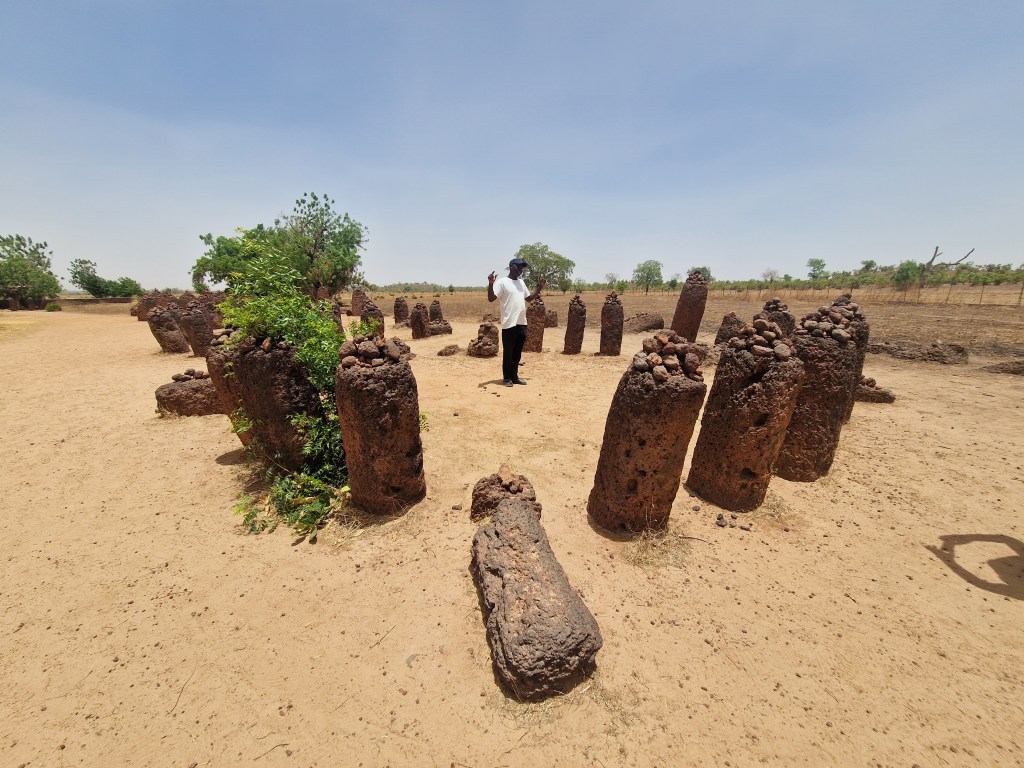
We drive about a half hour and stop at the Wazzu Stone Circles, an UNESCO World Heritage site.
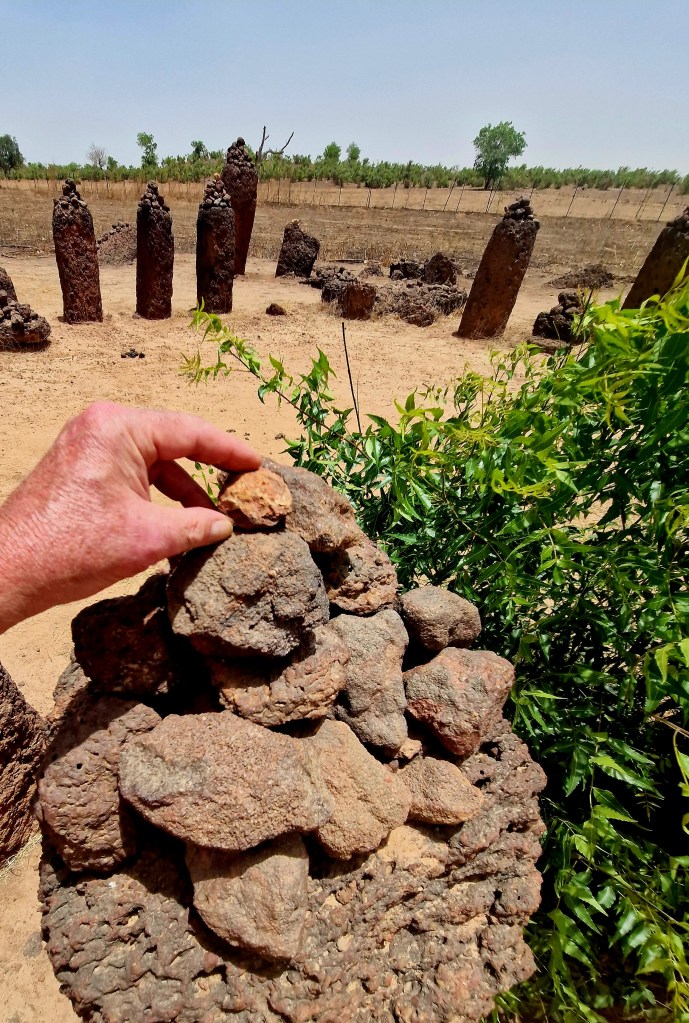
Each circle is kind of a mini Stonehenge but these circles of red stone columns are believed to be burial sites. The grave in the middle of each circle is oriented east-west with the head of the buried facing east to meet each sunrise forever.
I’m told by our guide that if you put a stone on top of a column and make a wish it will come true. So, I pick up two stones.
The guide at the site walks us from one stone circle to the next, explaining things about these features in the dry, flat terrain.
Near the end of the twenty minute tour I get my chance. I place a stone on top of a column which already has a pile of stones on it.
I wish for good health, happiness and safety for my two dogs. I walk to another circle and place a stone on another column, also loaded with stones on its top, some barely hanging on.
I hope to see an extraordinary young Welsh woman again.
We continue the drive past a landscape of leafless baobab trees, the iconic monster trees of this region. The baobabs will leaf out when rain returns in June.
Our driver doesn’t drive fast. Good. We pass through villages, each with a speed bump or two, some with police checkpoints. Most of the checkpoints are unmanned so they’re just an obstacle course for vehicles. Swerve left around the partial barrier then right avoiding another, then left and right again. All part of the drive.
The heat reaches 40C or 104F. The air is dry and dusty. The horizon is a brown haze. The road is a fine blacktop and I have a thought that I’m sure I could buy an egg from one of the many tiny shops, break the egg on the road and fry it.
Maybe, I think, I should buy a green pepper and an onion and make an omelet. Just an idea or a hallucination? The heat is real and taking its toll.
Two days ago while standing on the dock at our bush camp on the river, waiting for a good sunset, the sun dropped but never made it to the horizon on the Gambia River. It sank into the dirty sky and disappeared. Disappointment. I was expecting it to set in the broad river with a sizzle and cloud of steam.
We drive onward. At one village we stop, get out mainly to stretch legs but decide to look for a cold drink, water and a snack. We find a tiny shop with a baby sitting in the entrance, guarded by her mother, the shopkeeper.
She pulls some cold, African made sodas from a fridge and we buy water, the sodas and a pack of strawberry cookies. The cookies last about two minutes after we start driving again.
More dry, dusty terrain slides by. The dust adds another layer of sun protection to my sunscreen smeared face.
We pass a lagoon with banks caked in salt, colored white to orange. Livestock frequently causes us to slow down and weave through them though we don’t know if they will continue their direction or be spooked into a bad decision, into our van.
We come to another village and this time at a checkpoint two police officers, one male, one female, stop and question us.
“Where are you going? Where did you come from? Where are you staying?”
Our young driver acts intimidated which only emboldens the police.
I try to answer a question and the officer apparently doesn’t understand my pronunciation of a town name. I don’t think he would like anything I would say.
The male officer says, “Give me water!”
I reach for one of my 1.5 liter bottles and give it to him. I give him the bottle with the hottest water, the one so warm you could make soup. I still have the bottle with cool water though it won’t stay cool for long.
We’re close to Gambia’s northern border with Senegal, just kilometers away most of the drive, a possible reason for the many checkpoints.
The sun continues to blaze. Goats roam, looking for shade. The grass has turned to straw.
The van starts to make a clattering noise under the hood. We have 50 km to go but we have to stop to check out the noise.
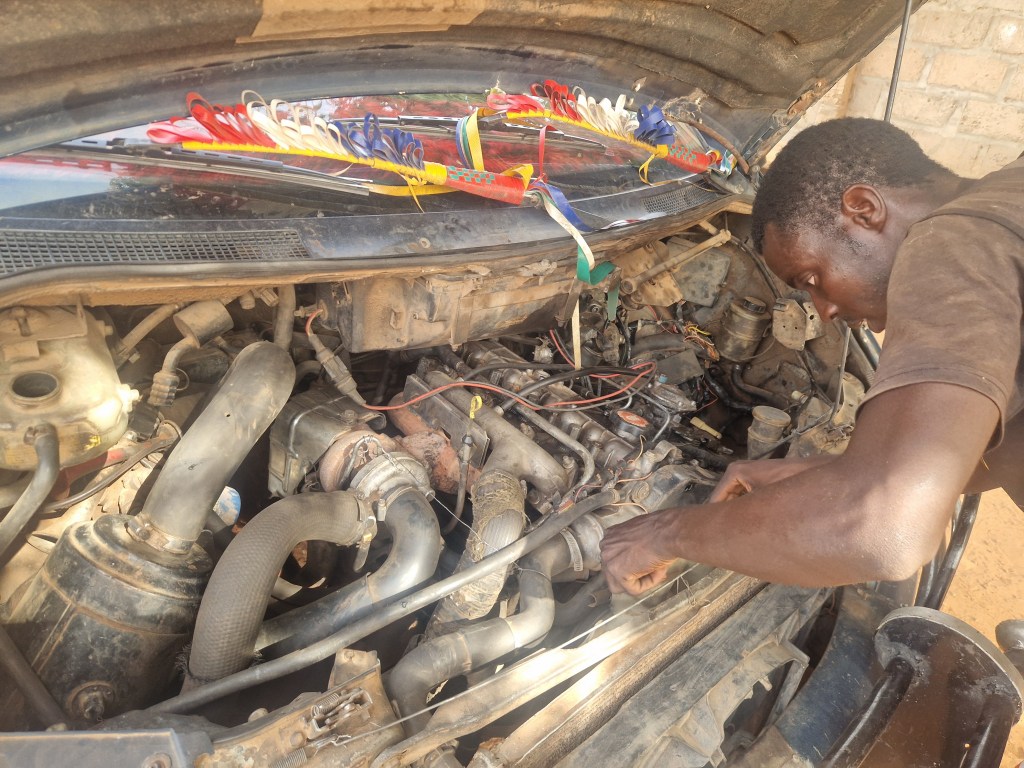
Our driver opens the hood and we all look in ready to fix this problem with no knowledge or tools.
I see a water reservoir with a missing cap. I find a rubber cover for who knows what just sitting in the engine compartment. There’s wire pulling a hose away from the fan.
The fan is the problem. It’s hitting something with each turn. This doesn’t look good.
The driver disappears into a shop and then into an alley. Several other drivers of passing cars get out to share their car engine ignorance. We’re all sure staring at the dirty engine will fix it.
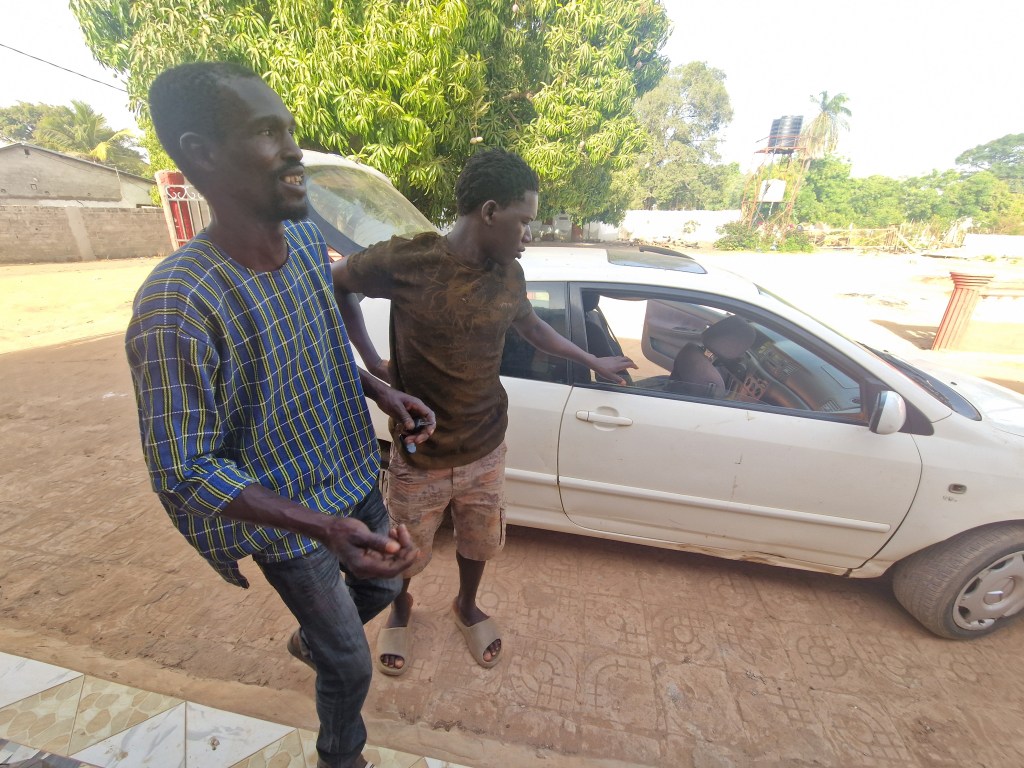
Our driver finds a guy who will drive us to our accommodation in a relatively decent little white Toyota. But, we don’t know exactly where we’re staying so we text the guy who set us up for this Gambia trip. His name is Dave, a Brit with Indian ancestry.
Dave furnishes the info but first, before we go any further our new driver has to stop and get his license and insurance information. You know, because of police checkpoints.
During the stop a bunch of little village girls swarm our windows to stare at white people, I guess.
I ask, “How was school today?” They say there was no school today. I ask, “What’s for dinner?” They don’t understand.
We drive on at a very respectable high speed. There are people walking down the road in our lane. Our new driver doesn’t move over and the people have to practically jump off the road.
We’re moving much faster now. We’re getting there. But, it’s still hot at 4:30. Lee takes a photo of the outside temperature shown on the car console. It’s 41C or 106F.
Finally we arrive in Albreda, on the Gambia River where the river is about five miles wide and filled with salt water. The Atlantic is twenty miles away and the tides fill and flush the river twice a day.
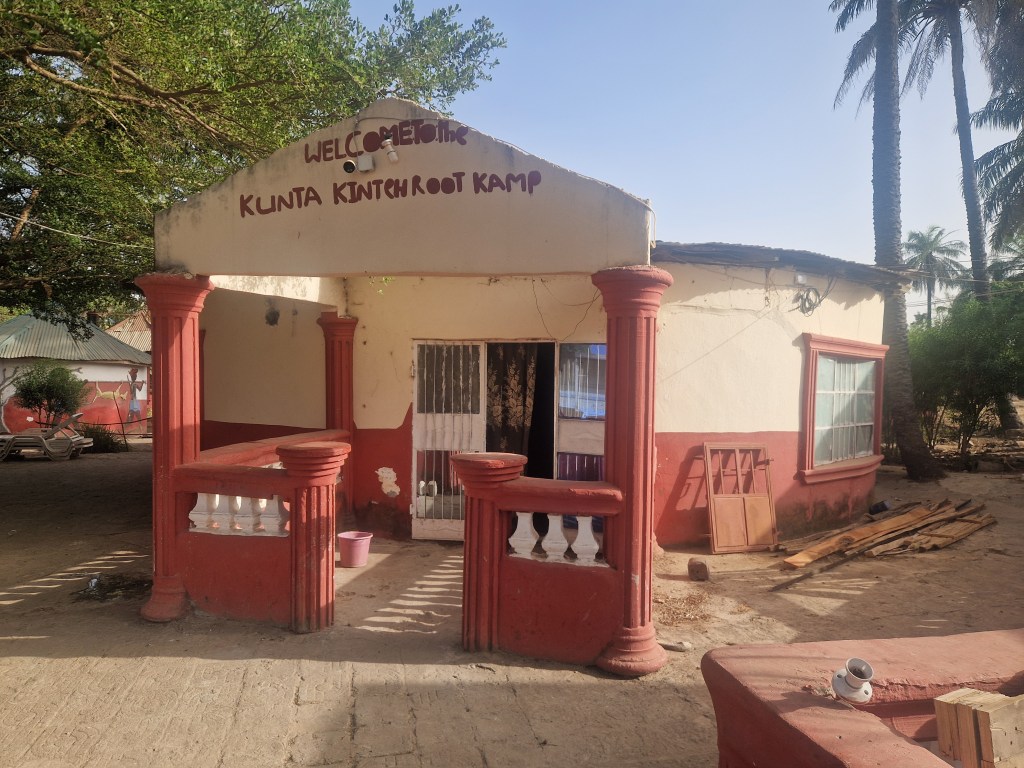
Finally in Albreda we find our place. Finally. Cheers
 Mike's Site
Leave a comment